My research focuses on offline and real-time electromagnetic transient (EMT) simulation of power electronic converters, specifically on the numerical integration techniques. Converters switch at high frequencies and often present stiffness, so accurate simulation demands a robust yet efficient numerical integration scheme; my work focuses on the exponential integrators that keep the simulation accurate while making it fast enough for real-time use and for large systems such as solid-state transformers.
Beyond numerical integration, I am interested in system modelling and in implementing EMT simulation on novel hardware platforms for accelerated simulation.
Publications
2026
- GPU Parallel-Rate Exponential Integrator Algorithm for Efficient Simulation of Power Electronic Systems
journal
IEEE Open Access Journal of Power and Energy, vol. 13, pp. 121–134, 2026
- A Numerically Efficient and Accurate Model for Real-Time Simulation of Solid-State Transformer Using Implicit-Explicit Integration Methods
journal
IEEE Transactions on Power Electronics, vol. 41, no. 6, pp. 10067–10085, 2026
- A Decoupled Detailed Equivalent Model for Accelerated EMT-type Offline and Real-time Simulation of Three-Port DAB-MMC with BESS
journal
IEEE Journal of Emerging and Selected Topics in Power Electronics, early access, 2026
2025
- Adaptive-Grained Exponential Integrator Algorithm for Efficient Simulation of Power Converter Systems
journal
IEEE Transactions on Power Delivery, vol. 40, no. 2, pp. 1114–1128, 2025
- High-Order Exponential Integrator Algorithm for Real-Time Simulation of Power Electronic Systems
journal
IEEE Journal of Emerging and Selected Topics in Industrial Electronics, early access, 2025
- High-Order Exponential Integrator with Network Decoupling for Numerically Efficient Simulation of Large-Scale Power Electronic Systems
conference
2025 IEEE 16th International Symposium on Power Electronics for Distributed Generation Systems (PEDG), pp. 1170–1174, 2025
- Universal Decoupled Equivalent Circuit Models of Solid-State Transformer for Accelerated EMT‐Type Simulation
journal
IEEE Transactions on Power Delivery, vol. 40, no. 5, pp. 2624–2641, 2025
2024
- Real-Time Simulation of Power Electronic Converters Using High-Order Exponential Integrator Method
conference
2024 IEEE Power & Energy Society General Meeting (PESGM), pp. 1–5, 2024
2022
- Real-Time Simulation of Hybrid Three-Level and Modular Multilevel Converter Based on Complete Equivalent Model for High Voltage Direct Current Transmission System
journal
IEEE Open Access Journal of Power and Energy, vol. 9, pp. 42–54, 2022
Earlier Projects
A few projects from my undergraduate degree that I am still fond of. Code that I choose to share is available on my GitHub.
Distributed Sensor Network for Production System Monitoring and Control
This was my capstone project for my B.A.Sc., it involved designing a low power wide area sensor node that had an onboard microphone and machine learning classifier. The sensor node would read in audio data, then the audio is filtered and processed to a particular audio sample where there is a disturbance. The onboard classifier would then make a decision about what was happening in the manufacturing plant. The data is then sent to a PLC where the control system makes a decision based on the data received from the node.
Each node uses LoRaWAN networking protocol, the ML classifier is onboard a Raspberry Pi running a Python script for collection and classification. The video above shows the entire system working.
CPU Design Project
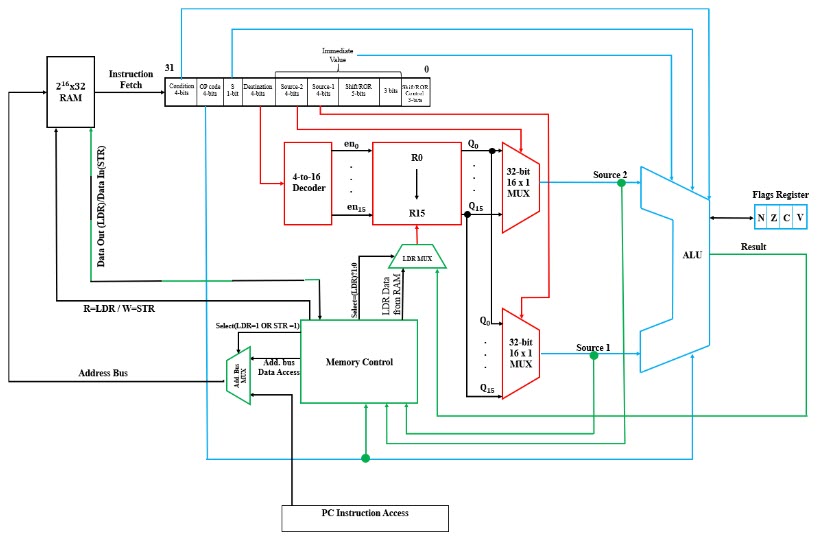
This project involved designing a 32-bit instruction CPU. The CPU follows ARM instruction decoding and communicates using a 16-bit address bus (2^16 RAM size). CPU has been testbenched in ModelSim. The entire program was written in Verilog.
CPU Scheduling Dashboard
This project showcases four basic CPU scheduling algorithms, including First Come First Serve, Round Robin, Rate Monotonic, and Earliest Deadline First. User can input up to four tasks, each task having an execution time, period, and release time. The dashboard assumes each task is predictably periodic after the initial release. Check it out here.
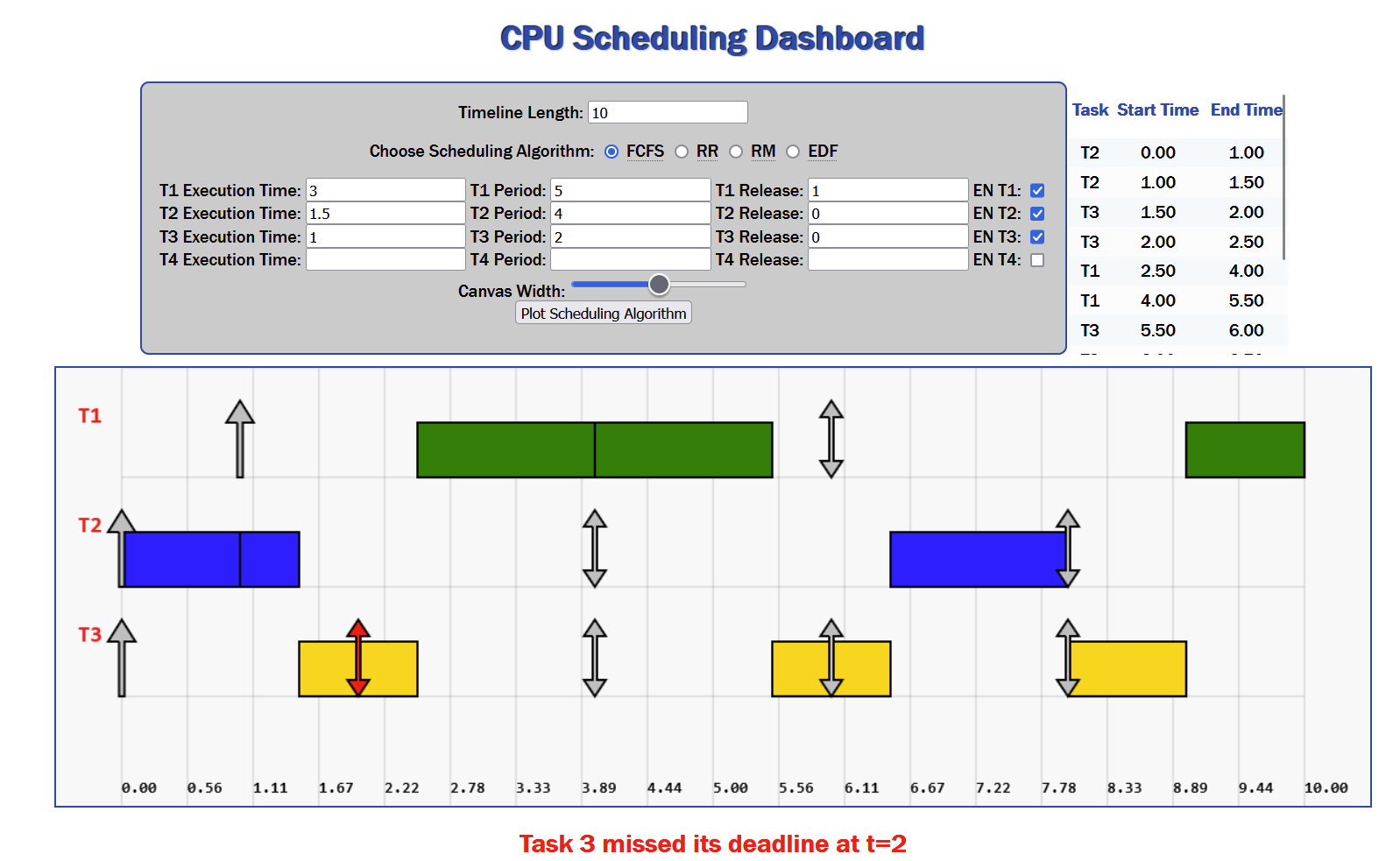
The code is modular and dynamically generated, it can be updated to include additional tasks with minimal work. The code is found here.
Solar Bench Project
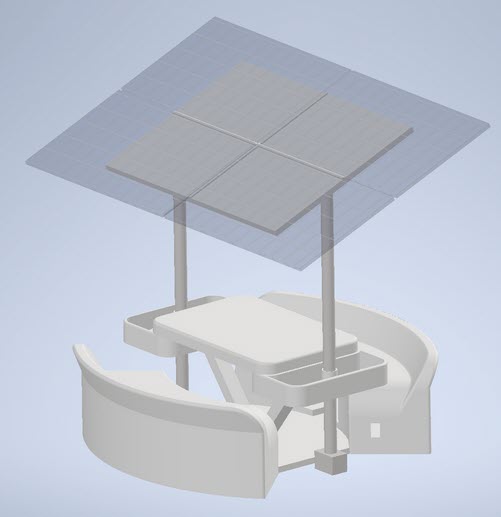
I was the lead electrical engineer for the on campus Innovate, Design, Sustain (IDS) club. We designed a bench that incorporates a PV system to store energy and allow students on campus to charge their devices outside. As lead electrical engineer, I led weekly meetings with general members and did the heavy lifting in terms of system sizing and safety considerations.